
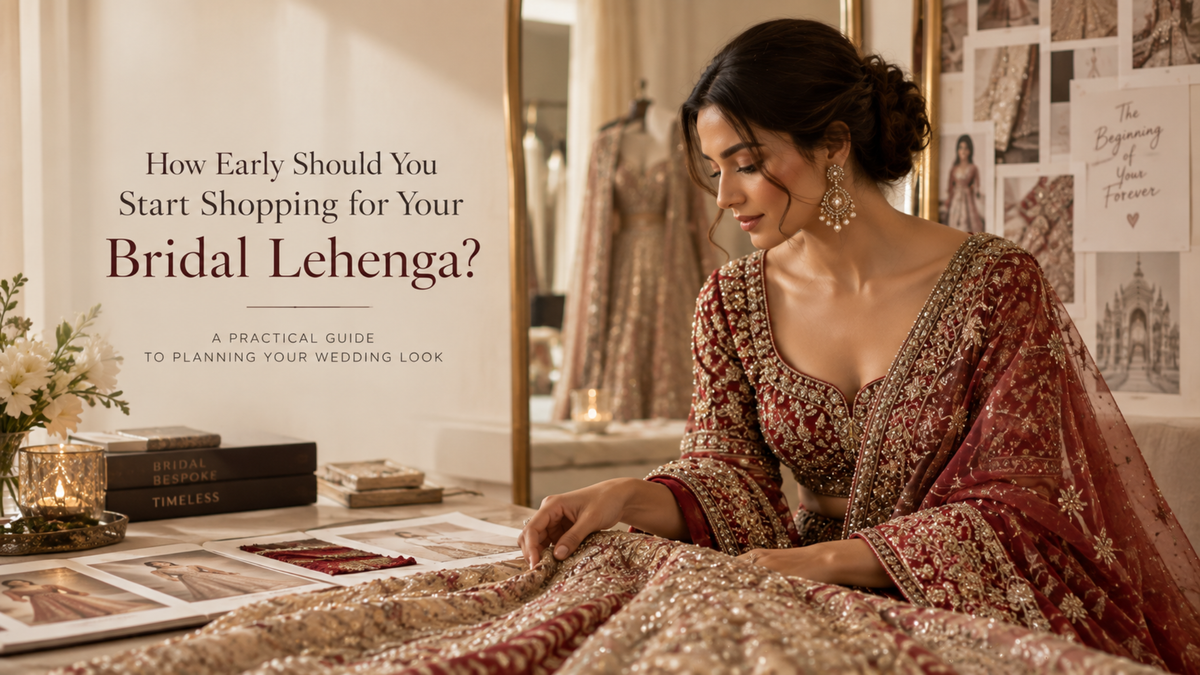
Your wedding is in December.
It’s September and someone in the family casually asks:
“Lehenga final ho gaya?”
Until that moment, three months probably sounded like plenty of time.
Now it suddenly doesn’t.
That is usually where the confusion around bridal shopping begins. One person will tell you she bought her lehenga six months before her wedding. Someone else found hers in one afternoon. Your cousin will insist you’re already late, while your mother will tell you not to buy too early because your size might change.
The truth is simpler:
There isn’t one perfect month to buy a bridal lehenga.
It depends on what you are buying.
A lehenga that is already available and needs minor alterations is a very different purchase from one being customized for you. And if the design involves changes to the embroidery, blouse, colour, fit or other details, you need to think beyond the day you place the order.
So instead of asking only “How many months before my wedding should I buy my lehenga?”, start with a better question:
“How much work needs to happen after I choose it?”
That will tell you far more.
If You Have Six Months or More, Start Looking Not Panicking
Six months before the wedding is a comfortable time to begin.
That doesn't mean you need to walk into the first store and pay for a lehenga that weekend.
Use this time to understand what you actually like.
Save references, of course, but don't let your Pinterest board make every decision for you. A silhouette that looks incredible on someone else may not feel like you once you put it on.
Try things.
Try the red you were certain you wanted.
Try the colour your mother keeps suggesting.
Try a fuller skirt and then something cleaner.
Try the blouse neckline you've saved twenty times.
And try at least one thing you wouldn't normally pick.
Sometimes the purpose of the first few appointments isn't to find the lehenga.
It's to discover what you don't want.
That alone can save you from making a very expensive decision too quickly.
Around Four to Six Months Is a Good Time to Get Serious
If you're considering a customized or made-to-order bridal outfit, this is when the conversation should become more specific.
Not:
“I want something in red.”
But:
What shade of red?
How much embroidery?
What kind of blouse?
One dupatta or two?
Will one dupatta go over your head?
How heavy do you actually want the skirt to be?
Is the wedding indoors or outdoors?
Are you going to be standing for photographs for an hour before the ceremony even begins?
These details sound small when you're scrolling through bridal looks.
They stop feeling small when you're the person wearing the outfit for several hours.
This is also the stage where you should ask the designer or store a very straightforward question:
“If I confirm this today, when will my outfit actually be ready?”
Don't assume.
Ask.
A realistic timeline should account for whatever work your particular outfit requires and leave enough room for fitting and corrections afterwards.
Don't Compare a Ready Lehenga Timeline With a Custom One
This is where a lot of bridal-shopping advice becomes confusing.
Your friend may tell you:
“Mine was ready in three weeks.”
That doesn't necessarily mean yours will be.
Maybe hers was already made.
Maybe only the blouse needed stitching.
Maybe the skirt needed a small waist adjustment.
Your outfit might involve different measurements, a different blouse, changes to embroidery or another level of customization altogether.
Both experiences can be completely genuine.
They're just not the same order.
So when someone tells you how long her bridal lehenga took, ask what was actually being made.
That context matters.
“But What If My Weight Changes Before the Wedding?”
This is one of the biggest reasons brides hesitate to shop early.
And it's a fair concern.
Bodies change. Wedding months are chaotic. Gym routines change. Stress changes. Eating schedules definitely change.
But waiting until the last minute isn't automatically the solution.
Instead, tell the designer or fitting team if you genuinely expect your measurements to change.
Then understand when they need your final measurements and how much alteration is realistically possible in the garment you've chosen.
This is especially important for the blouse.
A slightly different skirt waist may be manageable depending on its construction.
A blouse has much less room to hide a poor fit.
And on your wedding day, the blouse is going to appear in a lot of your close-up photographs.
So don't treat the fitting as something you'll “sort out later.”
When Should You Buy Your Jewelry?
There isn't one rule for every bride.
Some brides already have family jewelry they know they'll wear. In that case, the lehenga needs to be chosen with those pieces in mind.
If you haven't decided on jewelry yet, finalizing the outfit first can make the rest of the styling much easier.
Think particularly about the neckline.
A necklace you love and a blouse you love can both be beautiful individually and still look wrong together.
If possible, keep photographs and measurements of important jewelry pieces with you while discussing the blouse.
And once the outfit is far enough along, start looking at everything together rather than as separate purchases.
The wedding-day look is one look.
Your lehenga, jewelry, dupatta, footwear and hair aren't five independent projects.
Your Footwear Should Come to the Fitting
Please don't leave this until the night before the wedding.
Your footwear affects the lehenga length.
Even a small difference in heel height changes where the hem sits.
So once you've decided what you're likely to wear, take those shoes or something with the same heel height to the relevant fitting.
Then walk.
Actually walk.
Don't just stand in front of the mirror while everyone says, “Perfect.”
Walk across the room.
Sit down.
Get up.
Turn.
If you're wearing a dupatta over your head, try that too when possible.
The wedding day is not a photoshoot where you stand in one position.
You'll walk, sit, bend, greet people, climb onto a stage, get off it and probably discover at least one part of the venue nobody warned you about.
Your lehenga needs to survive the actual wedding, not just the fitting-room mirror.
What If You're an NRI Bride Coming to Delhi for Shopping?
Then your calendar matters even more.
If you're flying into Delhi for a limited number of days, don't plan the trip assuming you'll walk into a store, choose a customized bridal outfit and leave with everything completed.
Before travelling, speak to the designer or store.
Share your wedding date.
Explain when you're in India.
Ask what can realistically be completed during that visit and whether another fitting will be required.
If you're only going to be in Delhi once before the wedding, say that at the beginning not after the order is placed.
You may need a different process from a bride who lives twenty minutes away and can return for another fitting next week.
That doesn't mean customization is impossible.
It means the timeline needs to be designed around reality.
Peak Wedding Season Changes Things
A November or December wedding isn't happening in isolation.
There may be thousands of other weddings happening around the same dates.
Designers, embroiderers, tailors, photographers, makeup artists, venues everyone's calendar gets busier during peak wedding season.
So if your wedding falls during a particularly busy period, give yourself more room rather than less.
The question shouldn't be:
“What's the absolute latest I can order?”
That's not a useful target.
The better question is:
“What timeline gives us enough room to do this properly?”
Those are very different ways of planning.
What If You Only Have Two Months?
First: don't panic.
Second: don't pretend you have six.
Your options may simply need to change.
Instead of beginning with a completely new custom concept, ask what is already available, what can realistically be altered, and what level of customization is possible within your dates.
Be completely upfront about the wedding date.
A good conversation at this stage is not:
“Ho jayega na?”
It is:
“This is my wedding date. What can genuinely be done well within this time?”
You would rather hear a realistic answer today than an optimistic answer that becomes a problem two weeks before your wedding.
And if the timeline is very short, flexibility becomes useful.
Maybe the exact embroidery change isn't possible.
Maybe another colour is available sooner.
Maybe a ready piece fits beautifully and only needs thoughtful alterations.
The goal is still to find an outfit you love.
You just need to shop according to the time you actually have.
Don't Forget the Final Full-Look Trial
Once everything is ready, try the complete look together before the wedding.
Not just the lehenga.
The complete look.
Blouse.
Skirt.
Dupatta.
Second dupatta, if you're wearing one.
Jewelry.
Footwear.
Anything going on your head.
Then look for practical problems.
Does the necklace sit properly with the neckline?
Is the dupatta pulling the blouse?
Can you comfortably lift your arms?
Is the skirt length right with the actual shoes?
Can you sit without the blouse becoming uncomfortable?
Is anything scratching, slipping or heavier than you expected?
These are much easier problems to solve before the wedding day.
So, When Should You Actually Start?
If you want the shortest possible answer:
Start exploring around six months before your wedding if you can.
If you're looking at a customized bridal lehenga, use those early months to shortlist and begin serious conversations rather than assuming the garment can be created at the last minute.
But don't turn six months into another bridal rule.
A simpler outfit may need much less time.
A heavily customized piece may need more.
A ready lehenga may work on a considerably shorter timeline.
The right answer depends on the garment and the work involved.
Which brings us back to the question worth asking before you place the order:
“What exactly happens between today and the day I take this lehenga home?”
If you understand that process, you'll understand your timeline.
And you'll make a much calmer decision.
At Label Maninder Gulati, bridal pieces can be individually considered around the wearer, from fit and silhouette to the details that make the outfit feel personal. Because customised work needs time, we recommend beginning the conversation early and sharing your wedding date from the start.
Explore our Bridal and Lehenga collections for inspiration, or get in touch if you're planning your wedding look and want to understand what can realistically be created within your timeline.
The goal isn't to buy your bridal lehenga as early as possible.
It's to give the right lehenga enough time to become yours.

Join the conversation
Share your thoughts about this story.