

A Sangeet outfit has a slightly difficult job.
It has to feel special enough for one of the most energetic evenings of the wedding, photograph well under evening lights, survive a few hours of sitting, standing and meeting people and still let you dance when someone inevitably pulls you onto the floor.
That is why choosing a Sangeet outfit only by looking at how beautiful it appears on a hanger rarely works.
The better question is: will you still enjoy wearing it three hours into the evening?
For most Indian weddings, the answer comes down to getting four things right: how close you are to the wedding, the silhouette you choose, how comfortably it moves and how you style the complete look.
First, Dress for Your Role in the Wedding
There is a difference between dressing for your sister's Sangeet and attending a colleague's wedding function.
If you are the bride or groom's sister, a close cousin or part of the wedding party, it makes sense to choose something with more presence. A statement lehenga, an embroidered saree or a stronger Indo-Western silhouette can hold its own through family photographs, performances and the main celebration.
For a close friend or bridesmaid, you can still dress up considerably, but you don't necessarily need the volume or detailing expected from immediate family.
And if you are attending as a guest, a beautifully cut kurta set, saree, co-ord or lighter lehenga may actually look more appropriate than choosing the heaviest outfit available.
This sounds obvious, but it solves one of the most common wedding-shopping problems: being either noticeably underdressed or dressed like you are part of the immediate family when you aren't.
Start with your relationship to the wedding. Then choose the outfit.
If You're Choosing a Lehenga, Don't Mistake Weight for Occasion Wear
A lehenga is probably the easiest silhouette to associate with a Sangeet and for good reason.
It gives you movement, works beautifully in photographs and can feel festive without requiring too much styling around it.
But a Sangeet lehenga does not need to feel like a bridal lehenga.
For a sister, bridesmaid or wedding guest, lighter embroidery, printed surfaces, interesting blouse details, colour and a well-cut skirt can create far more impact than simply adding more work.
The difference becomes obvious once the dancing begins.
An outfit can look spectacular while you are standing still and become exhausting once you have spent an hour walking around the venue.
When trying a lehenga, don't just stand in front of the mirror.
Walk around in it. Sit down. Raise your arms. Turn. Take a few quick steps.
If you already need to hold the skirt every time you move, you have your answer.
For Sangeet-ready silhouettes, you can explore our Lehengas Collection and look beyond only the heaviest pieces.
A Saree Can Be Just as Good for a Sangeet
There is no rule saying Sangeet means lehenga.
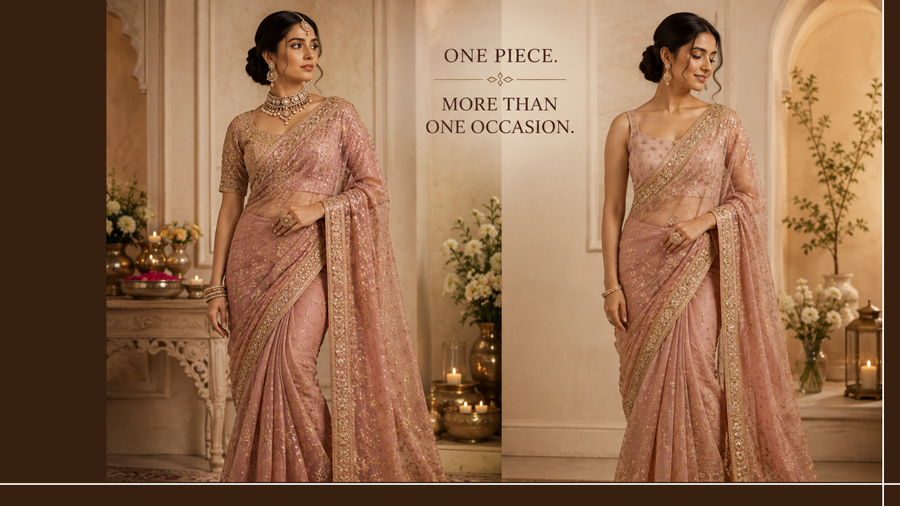
In fact, if you don't particularly enjoy wearing a lot of volume, a saree can be one of the strongest options for the evening.
The styling determines whether it feels right for the occasion.
A relatively clean saree paired with an embroidered or more structured blouse can work beautifully. Printed sarees can also make sense for a less formal Sangeet, particularly when jewellery and accessories bring enough depth to the overall look.
If dancing is going to be a major part of your evening, secure the drape properly before leaving.
This is not the night for a pallu that needs to be put back in place every five minutes.
And if you rarely wear sarees, don't choose an unfamiliar complicated drape simply because it looked good in a saved Instagram post. Wear the complete outfit once before the wedding and see whether you can actually move naturally in it.
Comfort shouldn't be visible. The goal is not to look comfortable.
The goal is to look properly dressed without spending the entire evening thinking about your clothes.
Don't Ignore Co-ords and Separates
A Sangeet is also one of the better wedding functions for moving slightly away from predictable dressing.
A festive co-ord can work particularly well if your personal style is more contemporary.
An embellished peplum with coordinated bottoms, an embroidered jacket with separates, a structured top with a skirt or a well-designed printed set can have enough presence for the evening without looking like another variation of the same wedding-guest lehenga.
There is also a practical advantage.
Separates are easier to wear again.
The skirt can later work with a simpler blouse. A jacket can be paired with a different kurta or bottom. A statement top can be styled with something quieter.
That matters when wedding season starts looking like one function after another.
Our Co-ord Sets are worth exploring if you want an occasion look that doesn't feel restricted to a single night.
Think About How the Outfit Will Look in the Evening
Sangeet is usually an evening function, and clothes behave differently under artificial lighting than they do in daylight.
This doesn't mean covering yourself in sequins.
It means paying attention to colour, texture and detailing.
Deep green, wine, maroon, rich blue, darker pinks and other saturated colours naturally hold their presence in an evening setting. Metallic embroidery, mirror work or carefully placed embellishment can catch light without the entire outfit needing to sparkle.
Softer colours can work equally well when there is enough contrast through the blouse, embroidery, jewellery or dupatta.
Instead of asking, “What colour is trending for Sangeet?”, ask whether the colour works with the construction and detailing of the actual outfit.
And if the family has given everyone a colour palette, that decision has already been made for you.
Your Dupatta Can Make or Ruin the Evening
A Sangeet is probably the worst occasion for a dupatta that only looks good when nobody moves.
If you know you will be dancing, keep the drape secure.
Pinning at the shoulder and waist can make a traditional lehenga much easier to manage. Depending on the outfit, a lighter dupatta, cape or jacket can be even simpler.
Also check the border.
A heavily worked border may look beautiful but can constantly pull the dupatta backwards if it hasn't been draped properly.
The same thinking applies to your blouse.
Raise your arms while trying it on.
If the armhole pulls, the neckline shifts or the blouse moves significantly, don't assume you'll somehow manage it at the function. Fix the fit before the wedding.
These are small details in a trial room and very large details once the music starts.
Jewellery Doesn't Have to Compete With the Outfit
Indian occasion dressing can quickly become a situation where every individual element is trying to be the statement piece.
If the lehenga is heavily embroidered and the blouse has a detailed neckline, you may not need an equally heavy necklace.
Statement earrings could be enough.
With a cleaner saree or co-ord, stronger jewellery can become the focus instead.
Look at the complete outfit rather than choosing each element separately.
And consider weight here too.
Those earrings may look perfect during the five minutes you spend trying them on. If they are already uncomfortable then, imagine wearing them through dinner, photographs and dancing.
There is no prize for making it to the end of the Sangeet with painful ears.
Please Try the Shoes Before the Wedding
Footwear deserves more thought for a Sangeet than it usually gets.
If you can comfortably spend the evening in heels, wear them.
If you can't, don't build the entire look around pretending that you can.
Block heels, wedges and embellished flats can all work depending on the outfit. Keeping juttis or another comfortable pair in the car is also perfectly sensible.
There is only one thing people often forget when planning to change shoes:
the length of the outfit.
If your lehenga has been altered while you are wearing high heels, switching to flats later may leave you with several extra inches of fabric on the floor.
Take the second pair to your final fitting if you know you're going to change during the evening.
If You Have a Performance, Rehearse in the Outfit Once
Not the whole performance.
Just the difficult bits.
Put on the blouse, skirt and shoes and try the movements that require the most range.
Can you lift your arms?
Can you turn properly?
Does the skirt get caught around your feet?
Does the dupatta stay where you pinned it?
Does the blouse move?
Does your jewellery start hitting your face when you turn quickly?
Ten minutes at home can catch problems you don't want to discover while standing backstage with your cousins.
Think About Where You'll Wear the Outfit Next
This is one of the easiest questions to forget while shopping for an Indian wedding.
“What happens to this outfit after the Sangeet?”
You don't need every purchase to be endlessly versatile. Sometimes you simply want a special piece for an important family wedding.
But for most wedding-guest wardrobes, having at least some rewearability makes sense.
A saree can look completely different with another blouse.
A lehenga skirt can be paired with something simpler.
Co-ord pieces can be separated.
A kurta set can be restyled with different jewellery and a different dupatta.
Even a statement jacket can move between several looks.
This doesn't mean buying something plain. It means looking for clothes that aren't dependent on one exact styling combination to work.
You can browse our Women’s Collection if you're building an occasion wardrobe rather than shopping only for one function.
So, What Should You Actually Wear to a Sangeet?
There isn't one correct Sangeet outfit.
A lehenga makes sense if you enjoy the movement and want something traditionally festive.
Choose a saree if that is a silhouette you naturally carry well.
Try a festive co-ord or separates if your style is more contemporary.
Wear a kurta or suit set when the celebration is smaller or you simply feel more like yourself in one.
What matters is that the outfit feels appropriate for your relationship to the wedding and the kind of evening you're attending.
Before making the final decision, put the complete look on once outfit, jewellery, dupatta and footwear.
Walk around.
Sit.
Raise your arms.
Take a photograph indoors.
And, yes, dance for a minute.
If you can do all of that without immediately wanting to adjust something, you're probably much closer to the right Sangeet outfit than any trend list could get you.
Because the best outfit for a Sangeet should get noticed when you arrive and then let you forget about it once the celebration begins.
For more ways to see Indian occasion wear styled as a complete look, explore The MG Edit from Label Maninder Gulati.

Join the conversation
Share your thoughts about this story.