
One wedding invitation arrives and suddenly your calendar looks like this:
Friday afternoon: Mehendi
Friday evening: Sangeet
Saturday: Wedding
Sunday: Reception
And just when you've figured out four outfits, there's another family wedding three weeks later.
Indian weddings give us plenty of reasons to dress up. They also create a very real wardrobe problem:
Do you really need a completely new outfit for every function?
Not necessarily.
Especially when you're investing in designer clothing, it makes more sense to think beyond one evening. A saree, lehenga, co-ord or kurta shouldn't become irrelevant simply because you've already been photographed in it once.
The better approach is to build a wedding wardrobe around pieces that can change depending on how you style them, what you pair them with and where you're wearing them next.
Here's where to start.
Before Buying an Outfit, Ask Where You'll Wear It After the Wedding
This is probably the most useful question you can ask while shopping.
Imagine you've found a lehenga for your cousin's sangeet.
It looks beautiful. The colour works. The embroidery is exactly what you wanted.
Now ask:
What happens to it after the sangeet?
Could you wear the skirt with another blouse?
Could the blouse work with a saree?
Could you replace the heavy dupatta with something lighter for another occasion?
If the answer to all three is no, you may be buying a very expensive one-night outfit.
That doesn't automatically make it a bad purchase. Some occasions deserve something extraordinary.
But it should be a conscious choice.
For most wedding guest wardrobes, versatility is worth thinking about before not after you buy.
Start With a Saree That Doesn't Belong to Just One Occasion
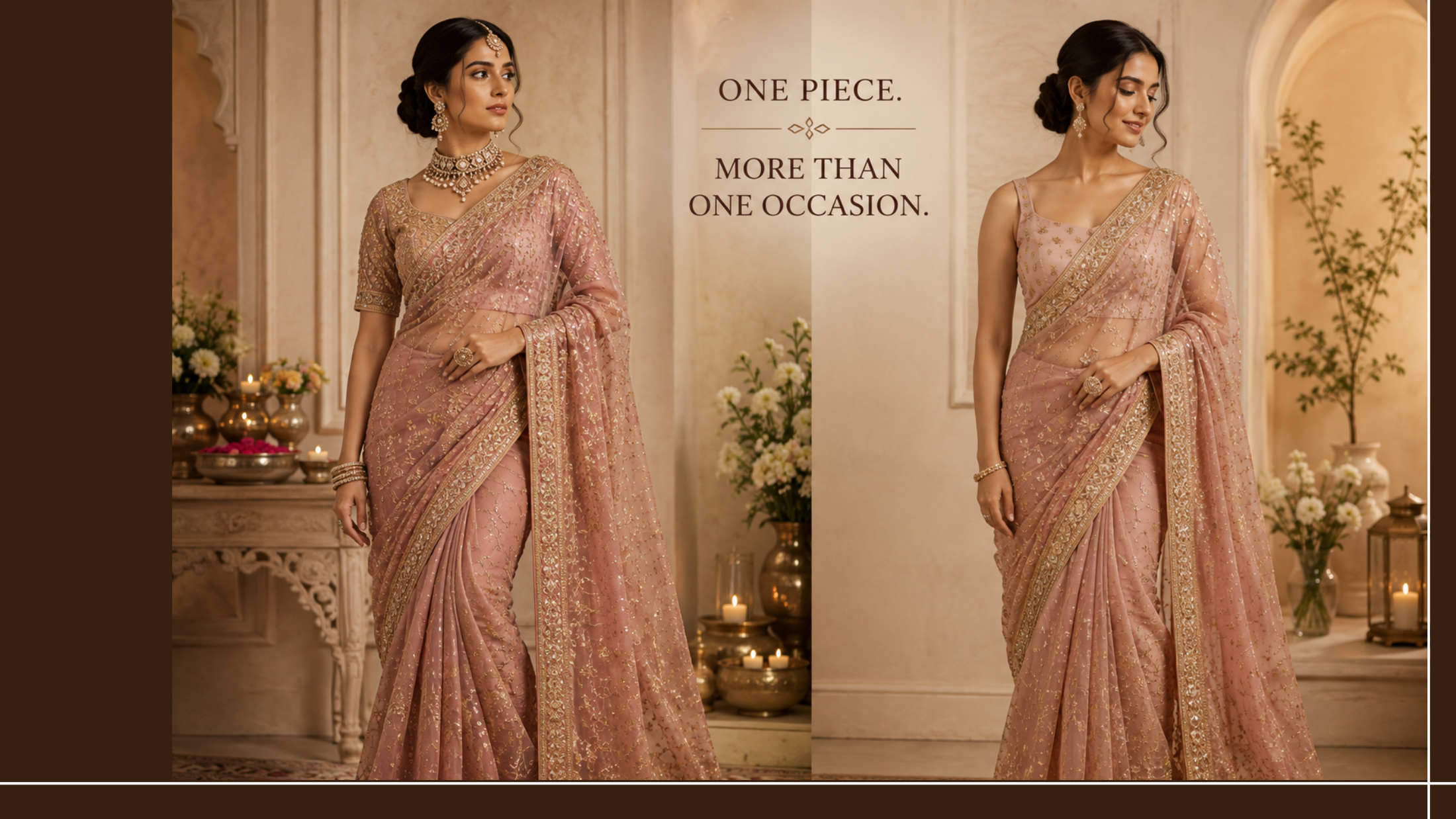
A good saree is probably one of the easiest pieces in an Indian wardrobe to bring back differently.
And the reason is simple:
The saree may stay the same. Everything around it can change.
Suppose you buy a beautifully embroidered saree for a family wedding.
For the wedding, you might style it with a statement blouse, jewellery, a more formal drape and dressed-up hair.
A few months later, the same saree could return for a festive dinner with a simpler blouse, lighter jewellery and softer styling.
For an evening reception, change the blouse again and take the styling sharper.
You haven't necessarily created three completely different outfits.
You've created three different moods from one good piece.
That's why, when investing in a saree, don't only ask:
“Is this beautiful?”
Also ask:
“How many versions of me could wear this?”
Your Lehenga Doesn't Have to Stay a Lehenga Set Forever
This is where people often miss an opportunity.
You buy a lehenga as:
Blouse + skirt + dupatta
and then mentally keep those three pieces permanently attached to each other.
They don't have to be.
Let's say you wore the complete set to your brother's wedding.
The next time, the lehenga skirt could work with a simpler blouse and lighter dupatta for a sangeet.
The original blouse might work beautifully with a saree.
A statement dupatta could be paired with a more restrained kurta set.
Even changing the jewellery, hairstyle and drape can reduce the feeling that you're repeating the exact same look.
This becomes even more useful when an outfit is being customised, because the pieces can be considered as part of your existing wardrobe, not designed in isolation.
If you already own three beautiful sarees, for example, a new blouse doesn't necessarily need to work with only the lehenga being made today.
It could be designed to work with something you already have.
That is when customization becomes genuinely useful.
“But Everyone Has Already Seen This Outfit”
This is probably the real reason many of us hesitate to repeat occasion wear.
Not because the outfit can't be worn again.
Because:
“I already posted pictures in this.”
Fair enough.
But repeating an outfit doesn't have to mean recreating the same photograph.
Take that same lehenga.
First wedding:
Statement jewellery.
Original blouse.
Full dupatta.
Hair tied back.
Next celebration:
Different blouse.
Lighter jewellery.
Dupatta draped differently or removed if the silhouette allows it.
Hair open.
The eye reads the whole look, not the purchase invoice.
You don't need to pretend it's a new outfit.
You just don't need to wear it exactly the same way every time.
A Good Co-ord Should Work Harder Than One Mehendi
Co-ords are particularly useful for Indian wedding wardrobes because they're already designed as separates.
You might wear the complete set to a mehendi.
Later, the top could work with a different skirt or trousers.
The bottom could be paired with a more understated top for a festive lunch.
Add a dupatta or statement jewellery and the same foundation can move towards another occasion.
But there is an important difference between buying something versatile and buying something plain.
Versatile does not mean boring.
Interesting embroidery, print, construction and craftsmanship can still give a co-ord personality.
The trick is making sure that personality doesn't depend entirely on all the pieces being worn together.
Build Around Pieces, Not Functions
Wedding shopping usually happens the other way around.
We say:
“Mehendi outfit chahiye.”
Then:
“Sangeet outfit chahiye.”
Then:
“Reception ke liye kuch aur chahiye.”
And suddenly we're shopping for three isolated wardrobes.
Try reversing the process.
Instead of starting with the function, start with what your wardrobe is missing.
Maybe you need:
One saree you can dress up or down.
One lehenga whose separates can work independently.
One contemporary Indian or Indo-Western piece for occasions where a full traditional look feels unnecessary.
One easier festive outfit for smaller functions.
Now when an invitation arrives, you're styling from a wardrobe rather than starting from zero.
That's a very different way to shop.
Men Don't Need a New Kurta for Every Wedding Either
The same thinking works particularly well for menswear.
Start with a beautifully fitted kurta and trousers or churidar.
For a smaller daytime function, wear the kurta on its own.
For a mehendi or family celebration, change the footwear and styling.
For a more dressed-up occasion, add a Bundi.
For another wedding, change the Bundi altogether.
One well-considered foundation can move through several levels of formality.
Fit becomes especially important here.
A kurta that fits beautifully will still look considered when worn simply. A poorly fitting kurta doesn't suddenly become better because you've put an expensive jacket over it.
So if you're deciding where to invest, start with fabric, cut and fit before adding more layers.
Close Family Is Different
There is one obvious exception to all of this.
If it's your own brother's, sister's or child's wedding, you may genuinely want different statement looks across the major functions.
And that's completely reasonable.
Not every fashion decision has to be optimized for maximum repeat wear.
But even then, thinking about the outfit beyond that one wedding can make the investment more worthwhile.
Perhaps the wedding lehenga is elaborate, but its blouse can return later.
Perhaps a heavily embroidered saree remains part of your occasion wardrobe for years.
Perhaps the groom's or close-family menswear can be restyled for another formal celebration.
The point isn't:
“Never buy something special.”
The point is:
When you do, make sure the design deserves a life beyond one photograph.
Customization Should Make an Outfit More Useful, Not Just More Personal
Customization is often discussed only in terms of measurements.
Sleeve length.
Neckline.
Blouse fit.
Garment length.
Those things matter, of course.
But customization can do something more useful.
It can make a new piece work with the wardrobe you already own.
Maybe you prefer sleeves because you'll feel more comfortable repeating the blouse later.
Maybe the lehenga needs pockets because you'll actually use them at functions.
Maybe a blouse can be designed so it works with both the new skirt and an existing saree.
Maybe a Bundi should complement more than one kurta.
These are small decisions when the garment is being made.
They can completely change how useful that garment becomes afterwards.
Don't Build a “Wedding Wardrobe” That Only Works at Weddings
This is the final test.
If everything you buy can only be worn at a large wedding, you'll still feel like you have nothing to wear every time a smaller invitation arrives.
Indian social calendars aren't made only of weddings.
There are Diwali dinners.
Anniversary celebrations.
Engagements.
Festive lunches.
Family functions.
Smaller pujas.
And plenty of occasions where you want to dress beautifully without looking like you've arrived directly from a baraat.
The strongest occasion wardrobes have different levels.
Something easy.
Something festive.
Something more formal.
And a few pieces that can move between them.
Buy for the Wedding. Think Beyond It.
There's nothing wrong with falling in love with an outfit simply because it feels right for a particular wedding.
Fashion doesn't always have to be practical.
But when you're investing in designer clothing, it's worth giving the garment a little more thought.
Don't only imagine yourself walking into the function wearing it for the first time.
Imagine the second time too.
What would you change?
A blouse?
A dupatta?
The jewellery?
The way it's styled?
If you can already picture another version of the outfit, you've probably found something worth keeping in your wardrobe.
At Label Maninder Gulati, our pieces are individually created and customised with the wearer in mind. Explore our Sarees and Lehengas, or visit The MG Edit for more ways of discovering and styling Maninder Gulati looks.
Because a well-made outfit shouldn't stop being useful when one wedding ends.
Join the conversation
Share your thoughts about this story.